February 16, 2026
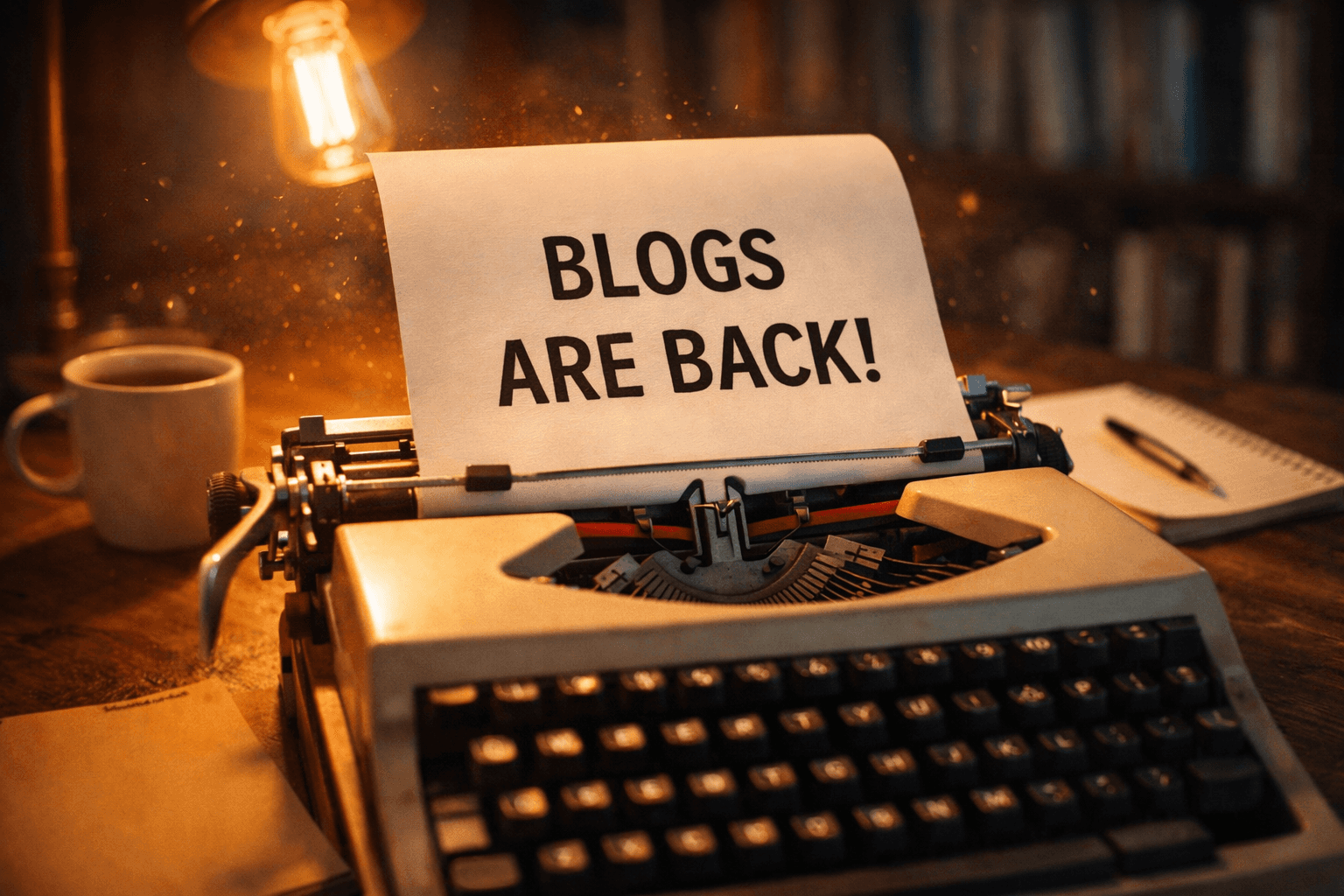
Blogs are making a comeback and here's what it means for Brands...
Gen Z didn’t just adopt matcha - they turned it into a lifestyle signal.
It was 11:37 PM on a Tuesday.
I was scrolling Twitter—the usual doom-spiral of takes, memes, and the occasional thing that made me stop.
Then I saw it.
Dan Koe's article. "How to Fix Your Entire Life in 1 Day."
150 million views.
Not a thread. Not a video. An article. On Twitter.
The platform that literally built its empire on 280 characters was now rewarding someone for writing 3,000 words.
And four days later, Elon announced Twitter would pay creators for long-form articles. A $1 million prize pool for the best ones.
I sat there staring at my phone thinking:
Wait. Are blogs… back?
Let me tell you what I've been watching happen.
For the last decade, every marketing expert told brands the same thing:
"Nobody reads anymore. Attention spans are dead. You need to be on TikTok. Instagram Reels. Short-form is king."
So brands followed the playbook.
They hired videographers. Bought Ring lights. Scripted 15-second hooks. Chased trending audio. Posted three times a day.
And you know what happened?
Their reach collapsed.
Because while they were optimizing for the algorithm, the algorithm was optimizing against them.
Instagram's organic reach? Down to 1-3% of your followers.
TikTok's "For You" page? A lottery ticket.
LinkedIn's engagement? Decimated if you dare to link externally.
Brands spent millions building audiences they don't own on platforms that don't care about them.
And now? The platforms are changing the rules again.
Here's what's actually happening in 2025:
Twitter (now X) launched long-form articles and immediately started paying creators for them.
Dan Koe's single article earned him $4,495 from the platform in 14 days. But here's the thing—that's pocket change compared to what it did for his business.
150 million impressions.
750,000 followers.
170,000 email subscribers.
And his actual income? $4 million a year.
Not from Twitter's revenue share.
From his newsletter. His courses. His products.
The article was the top of the funnel. The owned platform—his email list—was where the money lived.
And Twitter knew it.
Four days after Dan's article went viral, X announced:
Doubling the creator revenue pool
Increasing algorithmic weight for long-form content
$1 million prize for the best articles
Elon said it out loud: "TikTok fragmented attention into 15-second clips. We're going the opposite direction."
Even the platform built on brevity now rewards depth.
Meanwhile, email marketing is quietly eating everyone's lunch.
Here's the data brands don't want to look at:
Email marketing ROI: $36 for every $1 spent.
Social media marketing ROI: $2.80 for every $1 spent.
Let me say that again.
Email is 13x more profitable than social media.
Email conversion rates: 4.24% of clicks become purchases.
Social media conversion rates: 0.59%.
Email is 7x better at turning attention into money.
Email open rates: 42% average.
Instagram organic reach: 1-3% of your followers.
You're spending more to reach fewer people who are less likely to buy.
The math isn't mathing.
But here's where it gets interesting.
Newsletter platforms are exploding.
Substack hit 5 million paid subscriptions in early 2025—a 67% jump from 2024.
Beehiiv grew to 140,000 newsletters (up 60%) and nearly doubled revenue to $28 million.
Paid newsletter subscriptions generated $19M in 2025 vs $8M in 2024—a 138% increase.
Creators are realizing what brands haven't:
You don't own your social media audience. You rent it.
And the landlord keeps raising rent while cutting your utilities.
Let me show you what this looks like in practice.
Dan Koe has:
750K Twitter followers
1.2M YouTube subscribers
170,000 email subscribers
Guess which number he cares about most?
He said it himself: "I think your email list is the only true follower count. All other follower counts don't really mean anything."
Why?
Because when Instagram changes its algorithm tomorrow, his 750K Twitter followers might see 1% of his posts.
But his 170K email subscribers? They get every single message.
No algorithm. No suppression. No platform deciding whether his content is "brand safe" or "engagement bait."
He owns the distribution.
And that's worth millions.
Here's the part that should terrify every brand currently over-invested in social media:
Algorithms are designed to make you pay.
Instagram doesn't want your organic posts to work. They want you to buy ads.
TikTok doesn't want your profile to drive traffic. They want you trapped in the app.
LinkedIn doesn't want you linking to your website. They want you creating "native content" that never leaves their platform.
The entire game is designed to extract money from you while giving you less and less control.
And you keep playing because "that's where the audience is."
But here's what nobody's saying out loud:
The audience is in their email inboxes too. You're just not there.
Let me give you the numbers that prove this shift is real.
93% of people check their email daily.
58% check it first thing in the morning—before social media.
Email engagement lasts 12+ days.
Social media posts last a few hours.
Email is 40x more effective at acquiring new customers than Facebook or Twitter.
79% of Millennials and 57% of Gen Z prefer email over other brand communications.
Read that last one again.
Gen Z—the generation everyone said "doesn't do email"—prefers it over social media for brand communication.
Why?
Because social media is noise.
Email is signal.
Here's what I think is really happening.
For the last 10 years, brands chased "reach."
Followers. Views. Impressions.
Vanity metrics that made investors happy but didn't move revenue.
And platforms loved it. Because the more you chased reach, the more you needed them.
But in 2025, something shifted.
People are craving substance over stimulation.
They're tired of scrolling.
Tired of 15-second dopamine hits.
Tired of AI slop filling their feeds.
They want depth. And depth lives in long-form.
That's why Dan Koe's 3,000-word article got 150 million views.
That's why YouTube is now rewarding "meaningful creators" over viral stunts.
That's why Substack crossed 5 million paid subscriptions.
The pendulum swung too far toward short-form. And now it's swinging back.
So here's the uncomfortable question for brands:
What happens when the algorithm changes again?
Because it will.
Instagram will tweak the feed. TikTok will suppress external links. Twitter will prioritize verified accounts.
And you'll wake up one day with 100K followers and 47 views per post.
Unless you own your audience.
Email doesn't have an algorithm.
Blogs don't get shadowbanned.
Newsletters don't care if you're "brand safe."
You publish. They receive. That's it.
Let me tell you what this means for brands specifically.
Stop chasing viral.
Start building libraries.
Viral is a lottery ticket. A library is a printing press.
Every piece of long-form content you create:
Lives forever (unlike a 24-hour story)
Gets found in search (unlike a buried tweet)
Can be repurposed across platforms
Builds your owned asset
Most importantly:
It can be sent to your email list.
And that's where the money is.
Here's the playbook nobody's talking about:
Use social media to drive to owned platforms. Not replace them.
Twitter article → Newsletter signup
Instagram post → Blog link
TikTok hook → Email capture
Social media is the trailer. Your email list is the movie.
Right now, brands are spending $50K on a trailer that 1% of people see.
And they're confused why ticket sales are low.
Because nobody's watching the damn movie.
Let me give you the real numbers on what this costs.
Professional brand video: $5,000-$50,000 per video.
Timeline: 2-4 weeks.
Reach: 1-3% of your followers.
Lifespan: 48 hours.
Email newsletter: $0-$500/month (platform cost).
Timeline: Write it yourself in a few hours.
Reach: 100% of your subscribers.
Lifespan: 12+ days in their inbox.
Blog post: $0-$1,000 (if you outsource).
Timeline: A few days.
Reach: Infinite (SEO + shares + email).
Lifespan: Forever.
You're spending 100x more to reach 50x fewer people for 1/200th the time.
The math is screaming at you.
Here's what I wish someone had told me three years ago:
Every hour you spend creating content for a platform you don't own is an hour you're building someone else's empire.
Instagram doesn't care if your account grows.
TikTok doesn't care if your business succeeds.
Twitter doesn't care if you make money.
They care that you keep users on their platform so they can sell ads.
You are the content. You are not the customer.
And the moment you realize that, everything changes.
So here's what you do instead:
Start a blog.
Not a "company updates" page. A real blog with real insights.
Industry analysis. Case studies. Long-form thinking.
The stuff your audience actually wants but can't find anywhere else.
Build an email list.
Not a "sign up for our newsletter" checkbox buried in the footer.
A real value exchange. "Give me your email, I'll give you something worth reading every week."
Use social media to drive both.
Every Instagram post should end with: "Link in bio for the full breakdown."
Every TikTok should tease: "I wrote a 2,000-word deep-dive on this."
Every tweet should have: "Full article here."
Social media is the appetizer. Your owned platforms are the meal.
Let me show you what happens when you do this:
Dan Koe built a $4M/year business.
Not from social media.
From owning his audience.
Newsletter creators on Beehiiv generated $45M in 2025.
Not from Instagram sponsorships.
From owning their distribution.
Substack writers with 1,000 paid subscribers make $100K/year.
Not from going viral.
From building depth with people who care.
The creator economy is worth $191 billion in 2025.
And the creators winning aren't chasing algorithms.
They're building libraries.
Here's the truth nobody wants to say out loud:
Blogs never died. We just stopped valuing depth.
We chased what was easy to measure (views, likes, followers) instead of what actually mattered (trust, attention, revenue).
We optimized for the algorithm instead of the audience.
We built on rented land and called it a strategy.
And now the platforms are changing the rules again.
But this time, some of us aren't following.
Because here's what 2025 taught us:
Twitter built its empire on brevity. Now it pays for depth.
Instagram prioritized photos. Now it's all video.
TikTok banned links. Now they're testing them.
The platforms will keep changing. Your email list won't.
The algorithm will keep moving the goalposts. Your blog will stay where you put it.
The reach will keep dropping. Your newsletter will keep landing in inboxes.
Stop building on quicksand. Start building on bedrock.
So here's my challenge:
For the next 30 days, flip the script.
Spend 80% of your time on owned platforms (blog, email).
Spend 20% of your time on social (just to drive traffic).
Post one long-form piece per week.
Build one email per week.
Use social media to tease, not to deliver.
Track this:
Email list growth
Newsletter open rates
Website traffic
Conversions (not impressions)
After 30 days, compare:
Cost per subscriber (email vs social follower)
Engagement (email vs Instagram)
Revenue (owned vs rented)
I'm willing to bet email wins.
Not because social media is dead.
But because you don't own it.
And in 2025, ownership is everything.
Dan Koe's article got 150 million views.
But that's not why he's successful.
He's successful because those 150 million people could choose to join his 170,000-person email list.
And he owns that list forever.
No algorithm can take it away.
No platform can suppress it.
No billionaire can change the rules overnight.
That's the difference between reach and power.
Reach is borrowed.
Power is owned.
And right now, brands are choosing reach.
The smart ones are choosing power.
Blogs are back. Not because they're trendy. Because they're stable.
Newsletters are winning. Not because they're new. Because they're owned.
Long-form is rising. Not because attention spans grew. Because people are tired of being overstimulated.
The internet is swinging back.
Not all the way. But enough.
Enough that platforms built on brevity are now paying for depth.
Enough that creators are leaving social media for email.
Enough that the smartest brands are realizing:
Depth is the new differentiation.
Owned platforms are the new moat.
And substance beats stimulation every single time.
So stop renting. Start building.
Stop chasing viral. Start building libraries.
Stop optimizing for algorithms. Start optimizing for trust.
Because in 10 years, TikTok might be gone.
Instagram might be irrelevant.
Twitter might be something else entirely.
But your email list? Still there.
Your blog? Still ranking.
Your audience? Still yours.
The algorithm giveth, and the algorithm taketh away.
But what you own, you keep.
Choose accordingly.